Activity 5- Project Process

Part 1You have been assigned as a project manager for a small construction company and have been assigned your first project. The client feels they have a basic grasp on their requirements but also feels that they will know more as the project progresses.  Using your knowledge of life cycle models, identify two models that may work based on your knowledge of the project.   The scope of the project is as follows: 

  1. Requirement 1:  3 bedrooms
  2. Requirement 2:  2.5 bathrooms
  3. Requirement 3:  Pool 
  4. Requirement 4:  2 patios, one patio should be enclosed

Using your experience documenting scope, outline the problem/opportunity statement you are trying to solve for, 2-3 success criteria, and any assumptions, risks, or obstacles.  Part 2Create a Work Breakdown Structure (WBS) for the following scope:

  1. Requirement 1:  3 bedrooms
  2. Requirement 2:  2.5 bathrooms
  3. Requirement 3:  Pool 
  4. Requirement 4:  2 patios, one patio should be enclosed

Your WBS should be based upon your chosen Life Cycle Methodology and include any deliverables. Part 3

  1. Build a network diagram
  2. Identify the early start, early finish, late start late finish for each activity
  3. Identify the critical path
  4. Identify the duration of the critical path
  5. What is the float of Activity B
  6. What is the float of Activity H

ActivityPredecessorDuration in DaysAStart3BStart6cA, B12DB5ED4FC6GE,F8HE7IH3

Management case

I want a case study research on ELITE EMERGENCY PHYSICIANS (FORMERLY KNOWN AS ELKHART EMERGENCY PHYSICIANS): 550,000 PATIENTS 

Conduct research to capture the organization’s infrastructure and processes and the threats to personal health information (PHI) and to determine a strategy to mitigate the threats you anticipate.

Your Tasks 1. Experiment with the network architecture, try changing the numbers, types and sizes of layers, the sizes of fil

python convolutional neural network Exercise

USE Jupyter Notebook

NB: Please only do Tasks 1-2

We will combine what we’ve learned about convolution, max-pooling and feed-forward layers, to build a ConvNet classifier for images.

Given Code:

in[]from __future__ import absolute_import, division, print_function

# Prerequisits
!pip install pydot_ng
!pip install graphviz
!apt install graphviz > /dev/null

# import statements
import tensorflow as tf
import tensorflow.contrib.eager as tfe
import numpy as np
import matplotlib.pyplot as plt
from IPython import display
%matplotlib inline

# Enable the interactive TensorFlow interface, which is easier to understand as a beginner.
try:
tf.enable_eager_execution()
print(‘Running in Eager mode.’)
except ValueError:
print(‘Already running in Eager mode’)

in[]cifar = tf.keras.datasets.cifar10
(train_images, train_labels), (test_images, test_labels) = cifar.load_data()
cifar_labels = [‘airplane’, ‘automobile’, ‘bird’, ‘cat’, ‘deer’, ‘dog’, ‘frog’, ‘horse’, ‘ship’, ‘truck’]

in[]# Take the last 10000 images from the training set to form a validation set
train_labels = train_labels.squeeze()
validation_images = train_images[-10000:, :, :] validation_labels = train_labels[-10000:] train_images = train_images[:-10000, :, :] train_labels = train_labels[:-10000]

in[]print(‘train_images.shape = {}, data-type = {}’.format(train_images.shape, train_images.dtype))
print(‘train_labels.shape = {}, data-type = {}’.format(train_labels.shape, train_labels.dtype))

print(‘validation_images.shape = {}, data-type = {}’.format(validation_images.shape, validation_images.dtype))
print(‘validation_labels.shape = {}, data-type = {}’.format(validation_labels.shape, validation_labels.dtype))

in[]plt.figure(figsize=(10,10))
for i in range(25):
plt.subplot(5,5,i+1)
plt.xticks([])
plt.yticks([])
plt.grid(‘off’)

in[]# Define the convolutinal part of the model architecture using Keras Layers.
model = tf.keras.models.Sequential([
tf.keras.layers.Conv2D(filters=48, kernel_size=(3, 3), activation=tf.nn.relu, input_shape=(32, 32, 3), padding=’same’),
tf.keras.layers.MaxPooling2D(pool_size=(3, 3)),
tf.keras.layers.Conv2D(filters=128, kernel_size=(3, 3), activation=tf.nn.relu, padding=’same’),
tf.keras.layers.MaxPooling2D(pool_size=(3, 3)),
tf.keras.layers.Conv2D(filters=192, kernel_size=(3, 3), activation=tf.nn.relu, padding=’same’),
tf.keras.layers.Conv2D(filters=128, kernel_size=(3, 3), activation=tf.nn.relu, padding=’same’),
tf.keras.layers.MaxPooling2D(pool_size=(3, 3)),

in[]model.summary()

in[]model.add(tf.keras.layers.Flatten()) # Flatten “squeezes” a 3-D volume down into a single vector.
model.add(tf.keras.layers.Dense(1024, activation=tf.nn.relu))
model.add(tf.keras.layers.Dropout(rate=0.5))
model.add(tf.keras.layers.Dense(1024, activation=tf.nn.relu))
model.add(tf.keras.layers.Dense(10, activation=tf.nn.softmax))

in[]tf.keras.utils.plot_model(model, to_file=’small_lenet.png’, show_shapes=True, show_layer_names=True)
display.display(display.Image(‘small_lenet.png’))

in[]batch_size = 128
num_epochs = 10 # The number of epochs (full passes through the data) to train for

# Compiling the model adds a loss function, optimiser and metrics to track during training
model.compile(optimizer=tf.train.AdamOptimizer(),
loss=tf.keras.losses.sparse_categorical_crossentropy,
metrics=[‘accuracy’])

# The fit function allows you to fit the compiled model to some training data
model.fit(x=train_images,
y=train_labels,
batch_size=batch_size,
epochs=num_epochs,
validation_data=(validation_images, validation_labels.astype(np.float32)))

print(‘Training complete’)

in[]metric_values = model.evaluate(x=test_images, y=test_labels)

print(‘Final TEST performance’)
for metric_value, metric_name in zip(metric_values, model.metrics_names):
print(‘{}: {}’.format(metric_name, metric_value))

in[]img_indices = np.random.randint(0, len(test_images), size=[25])
sample_test_images = test_images[img_indices] sample_test_labels = [cifar_labels[i] for i in test_labels[img_indices].squeeze()]

predictions = model.predict(sample_test_images)
max_prediction = np.argmax(predictions, axis=1)
prediction_probs = np.max(predictions, axis=1)

in[]plt.figure(figsize=(10,10))
for i, (img, prediction, prob, true_label) in enumerate(
zip(sample_test_images, max_prediction, prediction_probs, sample_test_labels)):
plt.subplot(5,5,i+1)
plt.xticks([])
plt.yticks([])
plt.grid(‘off’)

plt.imshow(img)
plt.xlabel(‘{} ({:0.3f})’.format(cifar_labels[prediction], prob))
plt.ylabel(‘{}’.format(true_label))

NB: Please only do Tasks 1-2

Tensorflow documentation: from ‘tensorflow.org’ website: search: tf.keras.layers.BatchNormalization’

research paper: search on web: ‘proceedings.mlr.press/v37/ioffe15.pdf’
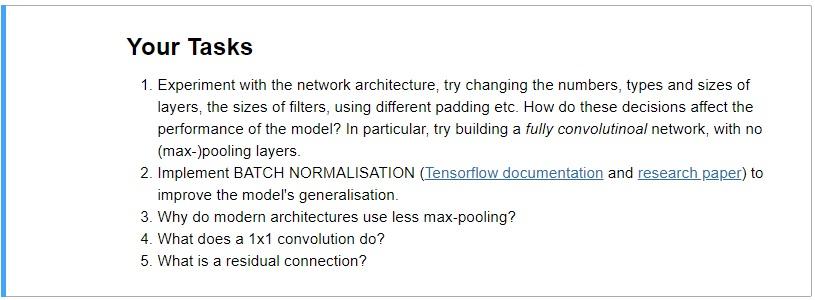
Your Tasks 1. Experiment with the network architecture, try changing the numbers, types and sizes of layers, the sizes of fil

NB: Please only do Tasks 1-2

Final Project


Final Project

For the final project, write a paper exploring themes at the intersection of technology and policy. Select one of the following topics:

•  Methods for reducing the level of international cybercrime

•  Coping with the fragility of and lack of security on the Internet

•  Establishing norms of national behavior in cyberspace, in peace and conflict

•  Developing national legal support for norms

•  The role and importance of declaratory national policies for cyberspace

•  Creation of international risk mitigation frameworks

•  Development of strategies that encourage international agreements

•  Assess the risk of catastrophic attacks on national infrastructure.

•  Should cyberspace be treated as a potential battlefield?

•  Explore the impact of commercial cyber-espionage on advanced economies.

•  Contrast European and American approaches to privacy on the Internet.

•  Explore freedom of expression via the Internet within autocratic regimes.

•  Must freedom of speech and association in cyberspace be sacrificed for cybersecurity?

Prepare an 8 – 10 paged paper that fully discusses the policies, events and technology for your selected topic using the brainstorming and analysis methodology. You should use current events, laws/regulations, technology and methods to support your opinion in your paper. You must include at least 5 reference resources. You should include a title page, table of contents, and reference page. Format your paper consistent with APA guidelines.

Nessus Report


VM Scanner Background Report, based on the Nessus Report. As you are writing your report, you may want to refer back to the CEO’s video in Week 1 to make sure your analysis and recommendations align with the CEO’s priorities and concerns.

You should link your analysis to the kinds of organizational functions and data associated with a transportation company (e.g., protecting order data, customer lists, sales leads, Payment Card Industry (PCI) compliance for processing credit, proprietary software, etc.) and provide your recommendation if Mercury USA should purchase the Nessus tool. This report should be four to six pages in length and include a title/cover page. Include in-text citations and a reference page with three quality sources in a citation style of your choice.

Activity to do


Activity 9-2 Avoid needs assessment problems. Some support analysts have expressed the view that the steps in a needs assessment project really should be described as:

1. unbridled euphoria

2. Search for the guilty

3. promotion of the involved

among other things.

Discuss each of these 3 – write 2 paragraphs (of minimum 6 sentences) for each.

blockchain development

 choose one of the Hyperledger design principles described in chapter 2, and explain why your chosen design principle is important to a successfully enterprise blockchain implementation. Then think of three questions you’d like to ask others at the end.

Computer 6

After reading about Business Processes think of a business of your choice. Think of the processes such as: taking an order, filling the order, and receiving payment.

Create a basic flowchart showing the high level steps used. Then create a second flowchart indicating where you would recommend improvements to the processes. Add a short 1 paragraph explanation of why you think your new process is improved.

Optional ideas to create your flowchart include Smart Art in PowerPoint, Word, Excel, or Google drawings/shapes in a Google document or similar software of your choice.

Operations and Buiness performance

 Based on the Harvard Business School Case “Trader Joe’s” prepare a 3-5 page case study analysis.  This paper should follow APA formatting, be double spaced, and include title and reference pages 

https://moodle.ab.edu/pluginfile.php/503404/mod_resource/content/2/TraderJoes.pdf