
The capability statement should contain the following sections:
- Technical Skills
- Non-Technical Skills
- Education
- Work Ethic/Motivation
- Role
- Social Media
- Schedule/Availability
+1 (231)-518-0303 [email protected]
Home » Archives for June 2023 » Page 372
The capability statement should contain the following sections:
Draw t
Exp19_Excel_Ch09_Cap_Housecleaning_Service
You manage a housecleaning service. As manager, you schedule the cleaners with clients, provide cleaning supplies, and insure the cleaners. You pay the cleaners for their time and mileage reimbursement. You set up a monthly workbook with one worksheet per week to enter the dates, mileage to each house, and start and stop times. You then calculate the hours worked. You are ready to calculate weekly totals and the monthly totals.
Start Excel. Download and open the file named Exp19_Excel_Ch09_Cap_HouseCleaners.xlsx. Grader has automatically added your last name to the beginning of the filename.
The title and column labels in the Week 1 worksheet are formatted with cell styles. You want to apply this formatting.
Group the Week 1, Week 2, Week 3, and Week 4 worksheets. Select the range A1:B1 on Week 1 and fill formats only across the other weekly worksheets.
Now you want to fill the formatting and contents to the other worksheets.
With the four weekly worksheets still grouped, select the range A11:E11 and fill both content and formatting across the other weekly worksheets.
You want to unlock the data-entry cells on the weekly worksheets.
With the worksheets still grouped, select the range A12:D40 and unlock the cells.
You want to create a data validation rule to control data entry.
Ungroup the weekly sheets, select the range D12:D40 in the Week 1 sheet, and then create a data validation rule with these specifications:
• Allow Time greater than cell C12.
• Enter the input message title: End Time.
• Enter the input message: Enter the end time. (including the period).
• Select the Stop error alert style.
• Enter the error alert title: Incorrect End Time.
• Enter the error message: The end time must be later than the start time. (including the period).
You want to duplicate the data validation rule on the other worksheets.
Select the range D12:D40 (if needed) and click Copy. Click the Week 2 sheet tab and group Week 2, Week 3, and Week 4 sheets. Select the range D12:D40, click the Paste arrow on the Home tab, select Paste Special, click Validation in the Paste Special dialog box, and then click OK. Ungroup the sheets.
Note: Paste Special validation is not available on Excel for Mac. Excel for Mac users need to repeat Step 5 to create validations on the Week 2, Week 3, and Week 4 worksheets.
Display the Week 2 sheet and insert a split bar between rows 22 and 23.
Although the data validation will prevent future errors in data entry, it did not correct errors in the existing data.
Display the Week 1 sheet. Circle invalid data to identify cells containing invalid end times. Display the Month sheet. In cells H4 and H5, indicate the name of the cells (e.g., A1) that contained the errors (do not enter a formula). Display the Week 1 sheet again. Change the first incorrect end time to 11:00 AM. Change the second end time to 4:15 PM.
The hourly rate you charge clients, the hourly wage you pay your housecleaners, and the mileage allowance are stored in a separate workbook. You will create links to those inputs to perform calculations in the weekly worksheets.
Open Exp19_Excel_Ch09_Cap_HouseInput.xlsx. Arrange the two open workbooks vertically to display both workbooks at the same time. Display the Exp_Excel_Ch09_Cap_HouseCleaners workbook and group the four weekly worksheets. In cell B5, multiply the Total Hours that is stored in cell B4 by the Customer Cost per Hour that is stored in cell B3 in the Exp_Excel_Ch09_CapHouseInput workbook.
In cell B6, multiply the Total Hours that is stored in cell B4 by the Cleaner’s Pay per Hour that is stored in cell B4 in the Exp_Excel_Ch09_Cap_HouseInput workbook.
In cell B7, multiply the Mileage that is stored in cell B3 by the Cleaner’s Mileage Reimbursement that is stored in cell B5 in the Exp_Excel_Ch09_CapHouseInput workbook.
Ungroup the worksheets, close Exp19_Excel_Ch09_Cap_HouseInput, and maximize Exp19_Excel_Ch09_Cap_HouseCleaners.
The Month worksheet was created to calculate the totals for the month. You will insert functions with 3-D references to add data from each worksheet.
Display the Month worksheet. In cell B3, insert a SUM function that uses a 3-D reference to add the mileage from the four weekly worksheets.
Copy the function from cell B3 to the range B4:B8. Use the Auto Fill button to Fill Without Formatting to preserve the original formatting in the range.
Now you are ready to calculate the weekly charge for Week 1.
In cell E3 in the Month worksheet, create a formula with a 3-D reference to display the contents of cell B5 from the Week 1 worksheet.
You are ready to enter similar formulas with 3-D references to display the total weekly charges for the other three weeks.
In cell E4 in the Month worksheet, insert a formula with a 3-D reference to display the contents of cell B5 from the Week 2 worksheet.
In cell E5 in the Month worksheet, insert a formula with a 3-D reference to display the contents of cell B5 from the Week 3 worksheet.
In cell E6 in the Month worksheet, insert a formula with a 3-D reference to display the contents of cell B5 from the Week 4 worksheet.
You want to create hyperlinks from the Month sheet to the cells containing the total weekly client charge for each week.
In cell D3 in the Month worksheet, insert a hyperlink that links to cell B5 in the Week 1 sheet. Include the ScreenTip text: Total client charges for Week 1 (no period).
Now you will insert hyperlinks to the second weekly worksheet.
In cell D4 in the Month worksheet, insert a hyperlink that links to cell B5 in the Week 2 sheet. Include the ScreenTip text: Total client charges for Week 2 (no period).
Now you will insert hyperlinks to the third weekly worksheet.
In cell D5 in the Month worksheet, insert a hyperlink that links to cell B5 in the Week 3 sheet. Include the ScreenTip text: Total client charges for Week 3 (no period).
You are ready to insert the last hyperlink.
In cell D6 in the Month worksheet, insert a hyperlink that links to cell B5 in the Week 4 sheet. Include the ScreenTip text: Total client charges for Week 4 (no period).
Create a footer on all worksheets with your name on the left side, the sheet name code in the center, and the file name code on the right side.
Protect each worksheet so that others can select the default cells but not make any changes.
Mark the Workbook as Final.
Note: Mark as Final is not available in Excel for Mac. Instead, use Always Open Read-Only on the Review tab.
9. Return to the PowerPoint presentation and navigate to Slide 8. a. Change the layout for Slide 8 to Title and Content. b. Add a table to the slide with seven columns and nine rows. c. Paste the data you copied from Excel into the table, and select Use Destination Style paste option. d. Where necessary, change the text in the header row to bold, White, Background 1 (the first color in the first row of theme colors).
Reading Resources:
Research Paper:
This week’s journal articles focus on transformational leadership and knowledge and knowledge sharing within an organization; please review these concepts and answer the following questions:
Google Scholar is a great source for research. Please be sure that journal articles are peer-reviewed and are published within the last five years.
The paper should meet the following requirements:
The writing should be clear and concise. Headings should be used to transition thoughts. Don’t forget that the grade also includes the quality of writing.
Note: plagiarism check required, APA7 format, include References, within 8hrs
USE Jupyter Notebook
Given Code: ‘Part of answer’ but incomplete…..
# Importing libraries

import pandas as pd

import numpy as np

from sklearn.neighbors import KNeighborsClassifier

from sklearn.tree import DecisionTreeClassifier

from sklearn.model_selection import train_test_split

from sklearn import metrics


# Loading the dataset

data = pd.read_csv('diabetes.csv')


# Separating features and target

features = data[['Pregnancies', 'Glucose', 'BloodPressure', 'SkinThickness', 'Insulin', 'BMI', 'DiabetesPedigreeFunction', 'Age']]

target = data['Outcome']


# Splitting training and testing data in the ratio 70 : 30 respectively

x_train, x_test, y_train, y_test = train_test_split(features, target, random_state=0, test_size=0.3)


# KNN model

modelKNN = KNeighborsClassifier()


# Train the model

modelKNN.fit(x_train, y_train)


# Predict test set

y_pred_knn = modelKNN.predict(x_test)


# Print accuracy of the KNN model

print(modelKNN.score(x_test,y_test))


# Print Confusion matrix

print(metrics.confusion_matrix(y_test, y_pred_knn))


# Print Classification Report for determining precision, recall, f1-score and support of the model

print(metrics.classification_report(y_test, y_pred_knn))


# Decision Tree model

modelDT = DecisionTreeClassifier()


# Train the model

modelDT.fit(x_train, y_train)


# Predict test set

y_pred_dt = modelDT.predict(x_test)


# Print accuracy of the Decision Tree model

print(modelDT.score(x_test,y_test))


# Print Confusion matrix

print(metrics.confusion_matrix(y_test, y_pred_dt))


# Print Classification Report for determining precision, recall, f1-score and support of the model

print(metrics.classification_report(y_test, y_pred_dt))
Please do the data cleaning and feature selection…
Please use the given code/layout given below original question….
ORIGINAL QUESTION:
“”for more info check original .ipynb file””
Fill out the code below so that it creates a multi-layer perceptron with a single hidden layer (with 4 nodes) and trains it via back-propagation. Specifically your code should:
First, initialise the parameters. This means determining the following:
Size of the network
Hidden layers (or a single hidden layer in this example) can be any size. Layers with more neurons are more powerful, but also more likely to overfit, and take longer to train. The output layer size corresponds to the number of classes.
Number of iterations
This parameter determines how many times the network will be updated.
Learning rate
Each time we update the weights, we do so by taking a step into the direction that we calculated will improve the accuracy of the network. The size of that step is determined by the learning rate. Taking small steps will slow the process down, but taking steps that are too large can cause results to vary wildly and not reach a stable optimum.
Next, fill in the code below to train a multi-layer perceptron and see if it correctly classies the input.
in[]# Reshape y
y =
# Initializing weights
W_1 =
W_2 =
# Definining number of iterations and learning rate(‘lr’)
num_iter =
learning rate =
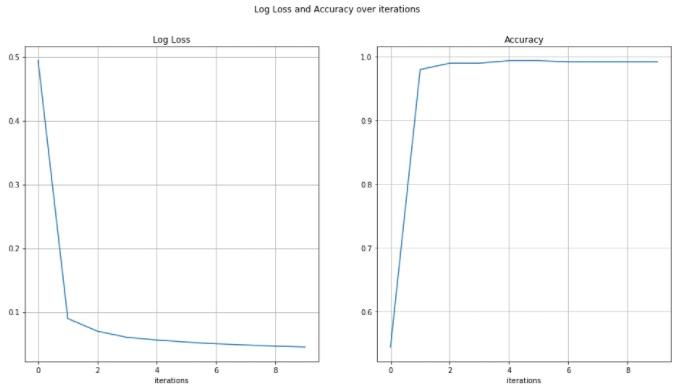
in[]# Creating empty lists for loss values(error) and accuracy
loss_vals, accuracies = [], []
for j in range(num_iter):
# Do a forward pass through the dataset and compute the loss
# Decide on intervals and add on the current loss and accuracy to the respective list
# Update the weights
in[]# Plot the loss values and accuracy
Higher number of iterations and lower learning rate seems to improve accuracy
This quiz is based on the material in Chapter 7 of the text.
Answer each these questions in a paragraph with at least five sentences: Include the question and number your responses accordingly. Provide a citation for each answer.
1. Describe Digital Literacy (how to know what is real on the web).
2. None of these people exist. What does this mean to you?
3. Why is Wikipedia more reliable than a paper encyclopedia?
4. How useful are crowd sources answers?
5. What are some drawbacks to crowd sourced answers?
6. Do people generally utilize the diversity of sources on the Internet effectively?
7. How reliant are we and how reliant should we be on getting our news from social media?
8. How do humans remain vigilant when we turn over authority to computers? Have you tried to navigate without gps?
9. If models are simplifications or reality, why do we rely on them?
10. Why was this model, used by Amazon for hiring, wrong?
11. Why did Skynet declare war on the human race?
Case 2- Window’s Steps Recorder
Dale Andrews, a desktop support technician, walked into the support center late one afternoon after a busy day diagnosing PC problems. He called out to anyone who was listening, “Help!”Dale explained to the support agents who were in the office that he had spent most of his day trying to replicate problems that several users were experiencing on their PCs. He said, “I spent several hours trying to figure out exactly what each user had done to cause the problems they reported. In some cases, I just couldn’t get the problem to reveal itself.
”As one of Dale’s desktop support colleagues, you suggested the support group investigate how to use a tool in Windows 8 called the Steps Recorder (this tool is called the Problem StepsRecorder in Windows 7, and in prior versions of Windows, it is called Screenrecorder). Several of the support staff expressed interest in this tool because they have all had experiences similar to Dale’s. Complete the following steps:”
Questions to answer:
1. Research how the Windows Steps Recorder works.
2. If you have access to a Windows PC, set up an example of a common problem, then use the Steps Recorder to try out the utility. For example, with the StepsRecorder running, open an application, such as Word or Excel, and try to open a document that doesn’t exist on your computer. You should get an error message. Next, inspect the output from the Steps Recorder to learn about the kinds of information it captured when you tried to open a file that doesn’t exist.AlthoughSteps Recorder only works with recent Windows versions, if you use Windows XP or Vista, you can try out a similar tool called Screenrecorder, which can be downloadedfromtechnet.microsoft.com/en-us/magazine/2009.03.utilityspotlight2.aspx.
3. Write a brief procedure targeted to end-users that explains how to use the Steps Recorder”
1. When developing a naming convention, what is the most important quality to keep in mind?
A. Logic
B. Consistency
C. Tradition
D. Filename length
2. What Microsoft program is frequently used to develop pictorial representations of a database’s logical relationships?
A. Excel
B. Word
C. Access
D.Visio
3. _refers to a set of tools for analyzing trends and patterns in business data.
A. MIS
B. Transaction
C. Business intelligence
D. Database management
4. What are the two main advantages to a well-designed relational database over other types?
A. Speed and data protection
B. Flexibility and data protection
C. Data integrity and speed
D. Data integrity and flexibility
5. What relationship does a data warehouse have to an organization’s data?
A. A data warehouse holds only the live version of the data.
B. A data warehouse holds all of the data.
C. A data warehouse holds only customer-related data.
D. A data warehouse holds only backup copies of the data.
6. When using a surrogate key, what form does the key most usually take?
A. Database owner name with incrementing numbers
B. Auto-incremented numbers
C. Random string of letters
D. Random characters beginning with
7. Which type of documentation should go inside your data dictionary?
A. List of software applications used
B. List of columns and data types
C. List of personnel working on the project
D. List of budget committee members
8. Which commercial RDBMS product was the first to hit the market and is the biggest?
A. Access
B. SQL Server
C. Oracle
D. MySQL
9. After an informative session, you find yourself with several pages of notes. For maximum retention and unde notes within _ hours.
A. 8
B. 48
C.24
D.12
10. When gathering the information needed to create a database, the attributes organization needs for its activities are _ requirements.
A. data
B. general
C. access and security
D. report
11. In a relational database, entities are defined by
A. rows.
B. columns.
C. values.
D. attributes.
12. You’re mapping out the logical relations of a database, and you notice that one of your tables will have a pair of child records for every record created in the parent entity. What type of relationship do these tables have?
A. One to many
B. One-to-one
C. Many-to-many
D. Pair of one-to-many relationships
13. If a user can make modifications to database objects, what permission has that user been assigned?
A. Select
B. Create
C. Update
D. Alter
14. The basic idea for relational databases was developed by Edgar Codd, who was a researcher for what company?
A.AT&T
B. IBM
C. Bell Labs
D. Siemens
15. During the information-gathering process, you want the system already in place. Which method would be best to us
A. Interviews
B. Review of business documents
C. Work shadowing
D. Questionnaires
16. Keys based on attributes that arise organically from the entity itself are referred to as what type of key?
A. Surrogate
B. Primary
C. Natural
D. Composite
17. Your project specifications call for a business rule that the database design can’t enforce. What tool should you use to enforce this busi
A. Exception
B. Weak entityty
C. Lookup entity
D. Trigger
18. Which type of entity describes a fundamental business aspect of a database?
A. Lookup
B. Domain
C. Weak
D. Linking
19. What visual practice provides more information about logical relations when creating an ERD?
A. Arrow notation
B. Referential actions
C. Crow’s feet notation
D. Color-coded boxes
20. Which type of relationship is logically supported but can’t be represented by Visio or any database modeling process
A. One-to-one
B. Many-to-many
C. Pair of one-to-many relationships
D. One-to-many
1. Which of the following functions is a scalar function?
A. COUNT
B. MAX
C.SUM
D. MONTH
2. What term is used to describe any action a database takes?
A. Function
B. Attribute
C. Transaction
D. Dependency a
3. Why should you perform the denormalization process on a database?
A. Increase data protection
B. Correct incorrect linkages
C. Correct attribute names
D. Improve performance
4. In testing, you find that one of the tables in your database has multiple versions of one of the columns, and updating the information requires the user to go to several different places to make sure the update completes. What process should you use to fix this kind of issue?
A. Denormalization
B. Normalization
C. Compiling
D. Insertion
5. Which operator signifies both the modulus operation and the wildcard in a WHERE clause?
A. %
0 B./
0 C.*
0 D.+
6. You’re looking for a DBMS to purchase and install for use with the database you’re designing. Because of future expansions, yi away from systems that have file size limits. Which of the following DBMSs should you likely avoid?
A. Access
B. Oracle Express
C.MySQL
D. PostGres
7. Which SQL functional area language contains all the commands for selecting and manipulating database data?
A. HTML
B.XML
C.DML
D.DDL
8. Which language is used to manipulate data and data objects in a relational database?
A. SQL
B.C++
C. XML
D.XQuery
9. You’re looking over the tables in the database you’re creating, and you another table. What type of Join are you seeing?
A. Cross join
B. Equi join
C.Outer join
D. Inner join
10. When users enter data into the database, they find they have to enter a value for every column, as the database won’t, otherwise. What type of value has been disallowed for this database?
A.O
B. Duplicate
C. Tab key
D. Null
11. What type of clause must you always use with DELETE or UPDATE to avoid Inadvertently changing data elsewhere in the data!
A. WHERE
B.ORDER
C.SET
D. FROM
12. Which keyword yields the same results as using the >= and <= operators?
A. IS
B. BETWEEN
C. LIKE
D. WHERE
13. _ are rules about how to do things.
A. Logs
B. Policies
C. Procedures
D. Reports
14. When a database system requests a login
A. Mapping
B. Authorization
C. Authentication
D. Permission
15. If you remove all the repeating groups or arrays from a database, which form is the database now in? 0
A. Fourth normal
B. Second normal
C. First normal
D. Third normal
16. Of the seven types of normal forms, how many are considered the most critical for creating a working database?
A. 3
B.5
C.2
D.4
17. A role is a collection of permissions, while a schema is a collection of
A. procedures
B. objects
C. attributes
D. reports
18. Which keyword should you use to Ffrovide a substitute name for a column?
A. AS
B.UPDATE
C. ORDER
D. SELECT
19. When checking the database, you confirm that the “Enforce Foreign Key Constraint” property is set to “Yes,” as expected. What property this constraint create for the database?
A. Referential integrity
B. Data redundancy
C. Third normal form
D. Functional dependency
20. If you wanted to assign a user the permission to create set
A. db_backupoperator
B. db_securityadmin
C. db datawriter
D.db accessadmin